

Financial health reviews are an essential aspect of nonprofit governance. Knowing the financial health of your society can provide insights into what moves may need to be made for growth, goal setting, and the feasibility of future projects.
Ensure Strong Financial Checks and Balances
Financial oversight is an essential part of governance and strategy, not a separate exercise. This will act as a checks-and-balances system for a financial health review. If finances are managed properly and around the clock, then there is less work needed to correct mistakes and verify data when the time comes for internal review.
At a minimum, Boards of Directors should have a clear understanding of their income, budget, revenue forecast, reserve levels (as a percentage of operations), key revenue streams such as membership, events, sponsorships, royalties, journals, and grants, and the trends in each of these areas.
It’s also important to know any major cost drivers and large profit or expense deviations from year-to-year. It’s not enough to just read and know the numbers; understanding why these deviations exist is equally imperative.
Financial health should be integrated into the ongoing dialogue between society leadership and management teams, supported through clear and transparent reporting and a shared understanding of goals and priorities. Your management team should not only be able to provide accurate financial reporting but also translate numbers into valuable insights, which in turn support informed decision-making.
Consistently Monitor Expenses
Financial health should be monitored continuously by the treasurer and your management team, and formally reviewed periodically by the Board of Directors or Finance Committee. Status Plus recommends that these more intensive reviews occur quarterly.
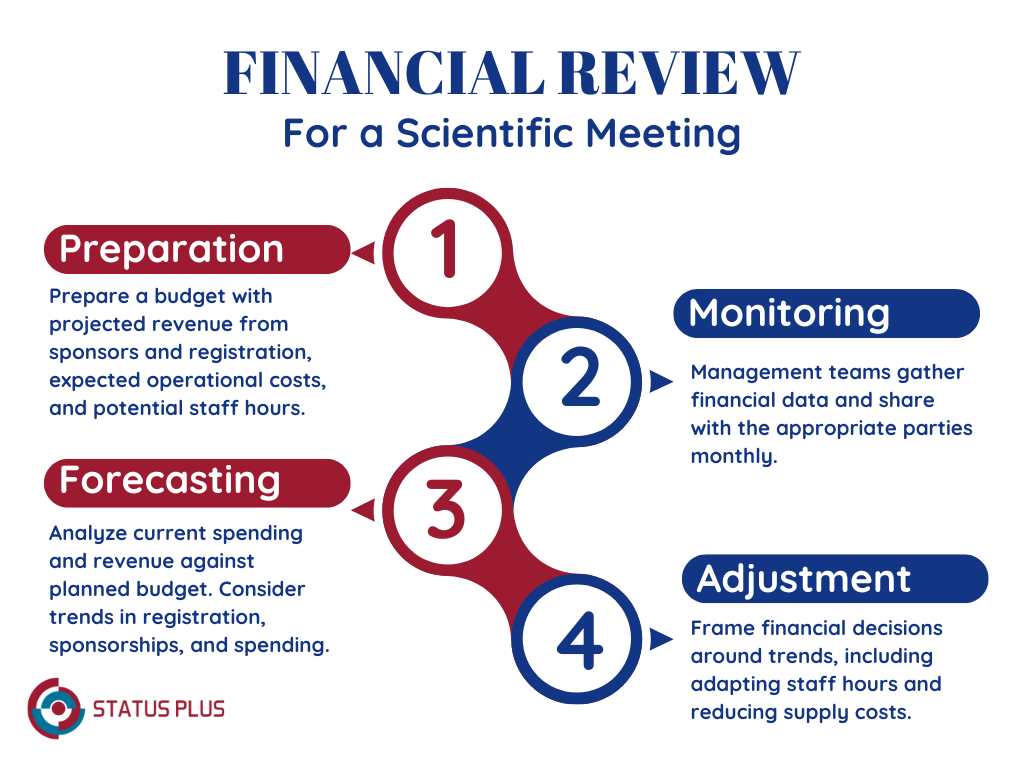
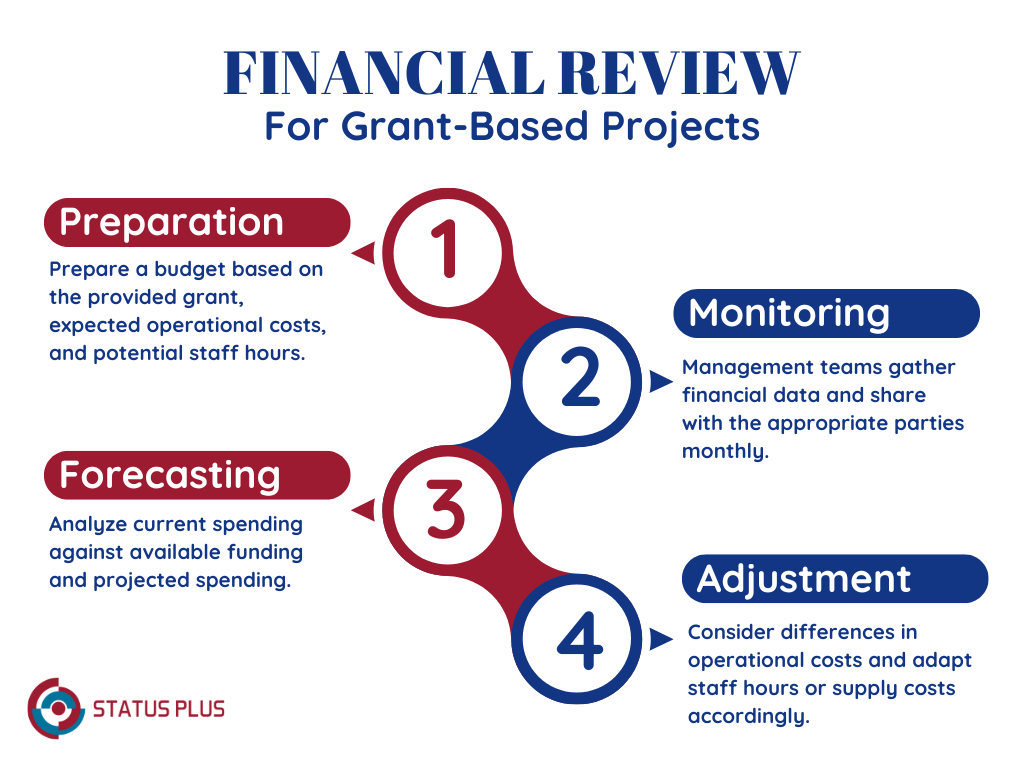
For management and operational purposes, monthly monitoring is key. However, when major events take place, such as meetings or instructional courses, more frequent reviews may be needed to check cash flow, registration, and sponsor revenue budgets compared with actual profits.
It’s beneficial for society leadership and management teams to work together to implement a review protocol (Figures 1 and 2) that fits the society well and allows for proactive, early intervention rather than a reactive approach.
Be Aware of Potential Blind Spots
It’s important to remember that financial health is more than just earnings and losses. Panic can be spared by avoiding these key mistakes:
- Looking only at year-to-year fluctuations rather than long-term trends,
- Relying on a limited number of revenue streams that historically have been stable but could pose a risk if circumstances change:
- One major event that has a sudden drop in attendance,
- Your biggest sponsor steps out.
- Not planning for unprecedented circumstances:
- Financial outliers such as an extraordinarily large meeting attendance one year compared to others.
- Legislative policy or tax changes disrupting standard processes.
- New technology like artificial intelligence or educational software potentially wiping out a longstanding revenue infrastructure.
- Misunderstanding how costs increase and evolve as the organization grows,
- Having goal misalignment on the Board,
- Assuming overall growth should be in line with revenue growth,
- This often doesn’t happen in nonprofits, as they develop a lot of charitable projects that cost more money than they gain.
- Not having insights into the real cost of new initiatives or programs and the benefit-cost ratio (BCR),
- Focusing too strongly on the profit and loss statement and less on underlying financial sustainability.
Communicating openly with finance teams to find gaps in understanding is the best way to set up for successful financial health reviews.
Assess Financial Performance Appropriately
Financial performance should be assessed at the project or program level, investigating which activities generate surplus and which require investment.
Not all initiatives need to be immediately profitable; if a project is strongly aligned with strategic or educational objectives, it may still be worth continuing. The key is to maintain a balanced portfolio, in which financially sustainable activities support mission-driven investments, ensuring overall financial health and long-term sustainability.
Organizations need to correctly allocate the required resources to execute their projects and programs to calculate a realistic BCR and measure profitability. Often, organizations state a program is profitable, but then don’t allocate the proper staff resources needed for program support. Essentially, it is important to account for the total number of hours worked in addition to the basic operational and software needs.
For example, a webinar is relatively inexpensive on the surface, needing at least a Zoom account and volunteer time. However, support staff time is also needed to organize and run the program. This often involves sending invitations to faculty, organizing attendee registration, disseminating communications and promotional materials, monitoring chatrooms and troubleshooting during the session, conducting post-event production (editing and posting video on website), and more.
Booking staff expenses under “operations” rather than “program” may not realistically match the budget in this case. Even though nonprofits are not aimed at making profits, they still need to behave like for-profit businesses at times. A realistic BCR is a simple metric to understand the financial impact of their programs.
Align Realistic Expectations with Strategic Goals
The most important action for leadership and management teams is translating financial outcomes into clear actions and ownership. This could be adjusting the budget, reprioritizing projects and programs, diversifying or strengthening revenue streams, or managing costs more actively.
It is also beneficial for financial outcomes to be linked to strategic goals, so financial decisions support long-term goals. Without tangible goals, it may begin to feel like project planning is going nowhere. Your management team should be able to support structured discussions, provide models or scenarios with accurate analyses, and ensure follow-up actions are defined and monitored.
Key Takeaways
- A financial review supports better decision-making and long-term sustainability.
- Boards and management teams must understand where the nonprofit stands, what risks exist, and where opportunities for growth or improvement are available.
- Without financial insight, it can be difficult for the Board to make informed, strategic decisions or respond effectively to changes in the field.
- Ensure your management team can provide support in assessing and analyzing society finances in a productive, proactive, and realistic manner.
Resources
Antonelli, A. (2025, August 25). Best practices for nonprofit financial health, part One: Top 3 measures of Financial Health. Nonprofit Finance Fund. https://nff.org/insights/best-practices-for-nonprofit-financial-health-part-one-top-3-measures-of-financial-health
Casalod, D., & Benitez, T. (2026, April 9) Personal Communication.
Council post: Nine key actions to financially safeguard your nonprofit. Forbes. (2025, August 25). https://www.forbes.com/councils/forbesnonprofitcouncil/2025/08/25/nine-key-actions-to-financially-safeguard-your-nonprofit/
Shah, N. (2024, March 20). Council post: 3 strategies for nonprofits to maximize cash flow management. Forbes. https://www.forbes.com/councils/forbesnonprofitcouncil/2024/03/20/3-strategies-for-nonprofits-to-maximize-cash-flow-management/